 A simple
process controller
A simple
process controller
RTES may be connected to I/O subsystems, instruments, PLC's, DCS's, Man-Machine interfaces.
Several RTES may be interconnected to form their own intelligent distributed control
system.
Depending on the application, RTES may operate as a host (master), a slave, or a peer.
RTES does not necessarily have to have a screen and keyboard. It may reside in EEPROM and not even require a disk.
Here are a few examples:
A simple
process controller
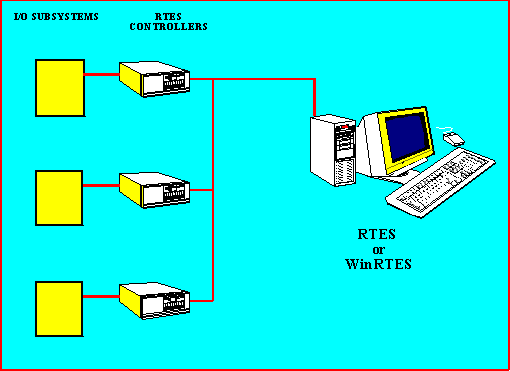
The process is distributed over a number of I/O subsystem and/or instrument interfaces
(non-intelligent I/O's, PLC's, analyzers, scales). A single PC handles the automation, data acquisition,
alarm handling, operator interface, reports, historical trend recording and play back. The PC may also
be accessed via telephone with a suitable 'co-session' software
 A
distributed controller
A
distributed controller
Using a serial (RS422/485) multidropped line, the activities of remote RTES controllers located at
various location in the plant are coordinated by one master RTES controller.
Using a LAN, all RTES controllers communicate peer-to-peer and operate as one single controller
with relevant data exchanged between them.
WinRTES as the master station provides a Windows based graphical interface, while the remote
stations handle the process automation.
 A multiple
site distributed controller
A multiple
site distributed controller
The remote RTES controllers are linked to the master station using dial-up telephone lines. The master
may call the remotes periodically to update its status, collect data, download set points and commands.
A remote may call the master to report a problem and/or at pre-determined times.
 Add
automation to your SCADA system
Add
automation to your SCADA system
The RTES controller communicates with SCADA using a popular protocol (AB, DNP3, MODBUS,
OPTOMUX) and performs various tasks such as heuristic control, fuzzy logic, batch process, statistics
(averaging, minima, maxima, trend, etc.)
This scheme is also used to connect to your SCADA additional devices using a protocol that it does
not readily support.

The RTES controllers operate as a distributed control system while the WinRTES stations offer a
Windows based human-machine interface.
An additional RTES controller on the network watches the activities of the operating controllers and
automatically takes over if one of them fails, stealing' the corresponding I/O subsystem by operating
one of the transfer switches.